
The Redline Report: A token makes an asset programmable. AI makes it intelligent. Together they turn private markets into self-driving assets.
Speed Read
- Two tidal waves are meeting. Tokenization is rebuilding the plumbing of capital markets; AI is rebuilding the work that runs on top of it. Each makes the other more valuable.
- The market is real, and still tiny. Tokenized real-world assets total $25–43 billion today. We size the serviceable market at $3.4–6.9 trillion by 2030, out of a $745 trillion universe.
- Public markets are the on-ramp; private markets are the prize. The largest unlock is private credit and private funds, where paperwork, not demand, is the constraint.
- The scarce asset is the terms model. Minting is solved. No one yet owns a living, machine-readable record of what each private credit asset is and obliges.
- 1+1=11: a token makes an asset programmable; AI makes it intelligent. The result is the self-driving asset. On our illustrative math, it creates $5–8 million a year of value per $1 billion of private credit, shared across managers, borrowers and investors.
The assignment: own the map of what your assets are before someone else does.
The Redline Reel
Watch in under 30 minutes, from beginner to expert.
- Start here: What Is Asset Tokenization? How Real-World Assets Go Onchain (explainer)
- The big picture: Larry Fink, BlackRock: “We’re at the beginning of the tokenization of all assets” (CNBC, October 2025)
- The public on-ramp: Vlad Tenev, Robinhood: “Tokenization will take over the entire financial system” (CNBC, August 2026, 7 min)
- The AI connection: Jenny Johnson, Franklin Templeton, on tokenization, AI and the future of finance (Proof of Talk, July 2026, ~14 min)
Part I: The convergence
Two transformation agents, one market
Every few decades, finance gets new plumbing: the telegraph, the mainframe, the internet. Each time, the winners were not the people who built the pipes but those who understood what could now flow through them.
We are living through two plumbing upgrades at once. The first is tokenization: recording ownership of stocks, bonds, funds, gold, loans and buildings on blockchains, where it can move, settle and be programmed around the clock. It is no longer a crypto sideshow: this month the Depository Trust & Clearing Corporation, which settles almost every US securities trade, launches its Tokenization Service. The second is AI, specifically the shift from chatbots to agents that read, reason, decide and act.
Most commentary treats these as separate stories. They are one. Tokenization creates a 24/7, machine-speed market that humans cannot operate and agents can. Agents need what tokenization provides: a trusted ledger, programmable money and assets they can hold. Each is the other’s missing half.
Cathie Wood saw it coming
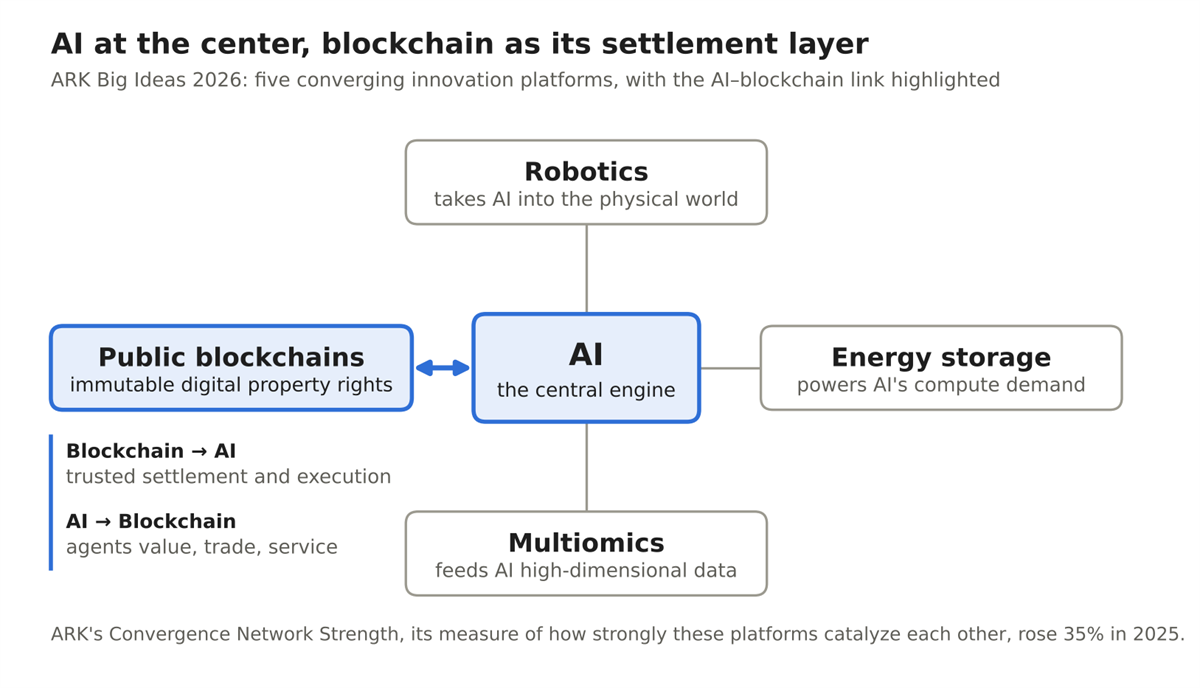
ARK Invest’s Big Ideas 2026, titled The Great Acceleration, argues that five innovation platforms (AI, public blockchains, robotics, energy storage and multiomics) now accelerate one another, with AI as the central engine. ARK’s Convergence Network Strength index, its measure of that cross-pollination, rose 35% in 2025.
The AI–blockchain link is among the clearest: blockchains give AI agents a trusted layer for settlement, and agents become the most active users of on-chain markets. ARK projects $11 trillion of real-world assets tokenized by 2030.
Blockchain and tokenization, without the jargon
A blockchain is a shared ledger that nobody owns and everybody can verify. Instead of every bank and custodian keeping its own copy and reconciling overnight, everyone works from one tamper-evident record.
Tokenization puts an asset’s ownership record on that ledger. A token says you own this slice of this thing: a share of Apple, a Treasury bill, a unit of a private credit fund, an ounce of gold. Three properties make it more than a digital certificate. It settles instantly, 24/7. It is divisible, so a $1 million minimum can become $1,000. And it is programmable: rules about who may hold it, when it pays and whether it can be pledged travel with the asset.
The third property matters most. A programmable asset can be operated by software. The question is whose software, and how much it understands.
Part II: The market
Small today, enormous tomorrow
Tokenized real-world assets, excluding stablecoins, are worth $25–43 billion, depending on the tracker (DeFiLlama, RWA.xyz, Token Terminal). An industry that cannot agree on what it owns has a data problem, not a ledger problem. Hold that thought.
Two numbers frame the opportunity. The total addressable market (TAM) is everything that could, in principle, be tokenized: every building, bond, share, gold bar and private fund. The serviceable addressable market (SAM) is the share that can realistically move on-chain by 2030 under today’s rules, technology and data.
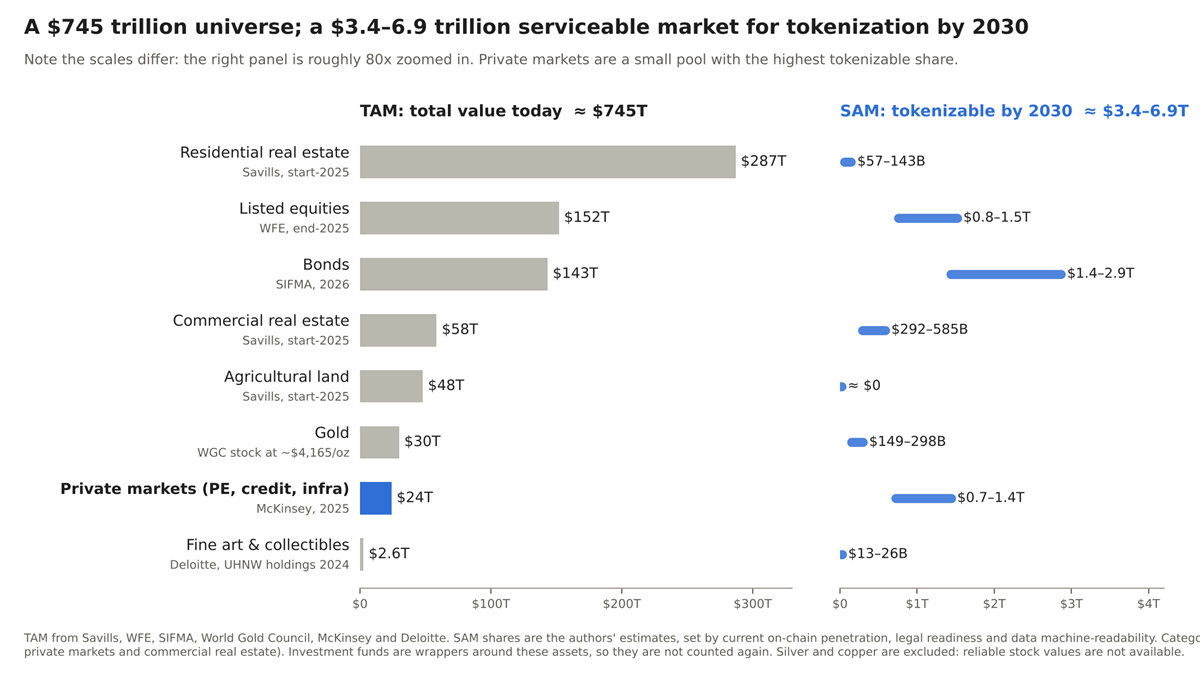
The TAM is roughly $745 trillion. We size the SAM at $3.4–6.9 trillion, under 1% of the whole. How we built it: each asset class gets a 2030 share based on three tests: how much is on-chain today, whether a legal path exists, and how machine-readable its data already is. Bonds score highest in dollars (1–2%), because tokenized Treasuries are proven and now have DTCC rails. Private markets score highest as a share (3–6%), because demand is strongest. Residential property and farmland score near zero. The result sits inside published forecasts (McKinsey $2 trillion, ARK $11 trillion) and brackets Citi’s $5.5 trillion.
Two honest caveats. A SAM is what can move, not a forecast of what will: at today’s 60–75% annual growth, the market reaches only $0.3–0.4 trillion by 2030, so getting to the SAM requires a step change in rails and data. And categories overlap at the edges, so the TAM is an order of magnitude, not an audit. Either way, even McKinsey’s conservative case means growing a $33 billion market 60-fold in four years, and the highest share sits in private markets, where data, not demand, is the binding constraint.
Public assets: the front door
On July 1, 2026, Robinhood launched Robinhood Chain, letting eligible users in more than 120 countries trade tokenized stocks around the clock and pledge them as collateral. It is marketed as purpose-built for AI agents. The fine print: the tokens are debt securities, not shares, and US customers are excluded.
Public equities are already liquid and priced every second; tokenization makes them always on. Useful, but incremental. The public playbook is a distribution race. The private playbook is a data race.
The bigger prize: private assets
Private markets hold about $16 trillion in traditional closed-end funds and roughly $24 trillion in total (McKinsey). Almost all of it sits behind $1 million minimums, multi-year lockups and quarterly PDFs: exactly the friction tokenization removes. Larry Fink’s 2026 BlackRock letter names private markets and infrastructure among the assets tokenization could open up.
| Asset class | Where it stands (2026) | Who’s doing it |
|---|---|---|
| Treasuries and money market funds | The beachhead: about $14.8B by mid-2026 | BlackRock BUIDL, Circle USYC, Franklin BENJI, Ondo |
| Private credit and funds | Largest category: about $18B of $36B in January; 8–14% yields | Figure, Apollo ACRED, KKR, Hamilton Lane |
| Commodities | Tokenized gold passed $6B | Tether Gold, Paxos Gold |
| Real estate | Most hyped, least real: under 1% of tokenized value | Mostly pilots |
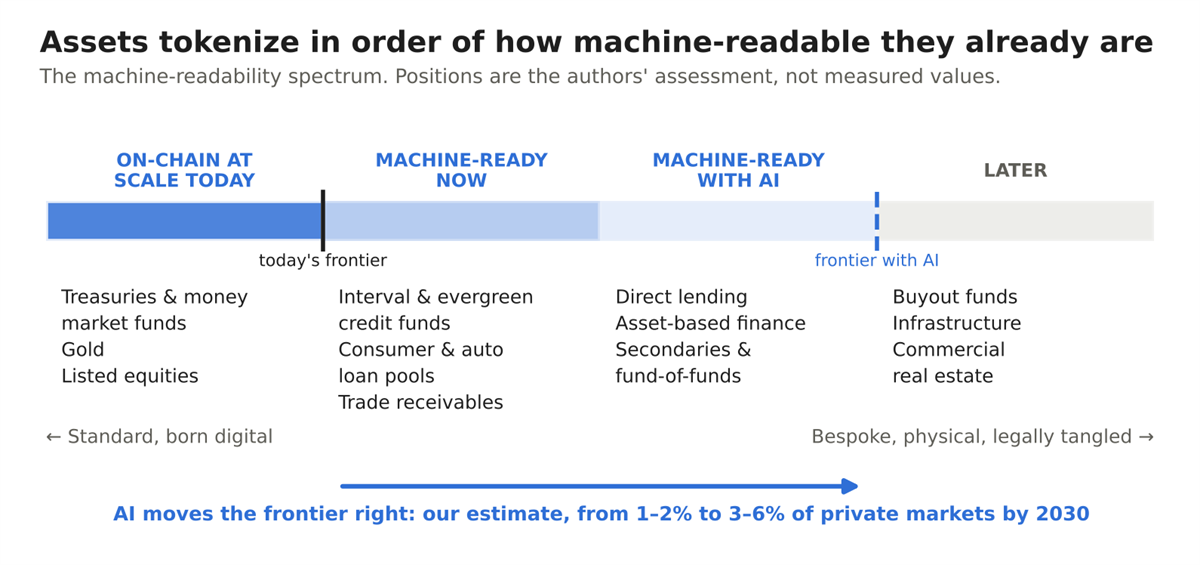
The sequence is not random. Assets move on-chain in proportion to how machine-readable they already are. A Treasury bill has one price and a standard contract. A private credit loan has a 200-page agreement and a trail of amendments. An office building has a title chain, leases and a roof that leaks. The harder an asset is to describe in data, the slower it tokenizes. That sentence is the whole argument for AI.
Picture the investor this unlocks. By 2030, her idle cash sits in a tokenized money market fund that moves on a Saturday. She owns $2,500 of a private credit fund that once demanded $1 million, priced continuously, sellable on a weekend and borrowable against. Her agent reads every offering document and flags a covenant breach before she does. (A token shrinks the minimum, not the rulebook: eligibility rules and lockups still apply until regulators change them.)
Part III: The intelligence layer
The bottleneck is the paperwork
Minting is solved; meaning is not. Putting a token on a blockchain takes minutes. Knowing what it represents, what it is worth and what its contract obliges still takes armies of lawyers and administrators; one leading platform’s documentation concedes that private-fund values are entered by hand. We built a 24/7 settlement system and fed it quarterly PDFs.
A blockchain proves a record was not tampered with, not that it was right. Garbage in, permanent garbage out. That gap is where AI earns its place, with six jobs from filing cabinet to wallet:
| AI’s job | In plain English | The payoff |
|---|---|---|
| Check it’s real | Reads deeds, cap tables and loan files; spots fraud and assets tokenized twice | A verified “passport” for every asset |
| Read the fine print | Turns fees, covenants and transfer rules into instructions the token can follow | The asset’s rulebook |
| Price it | Values hard-to-trade assets continuously | A live price, not a quarterly estimate |
| Police who can own it | Applies investor-eligibility and anti-money-laundering rules | Rules that travel with the token |
| Run the back office | Handles payments, distributions and investor reports | Paperwork on autopilot |
| Make it usable | Prices secondary sales and loans against the asset | Idle assets that can be sold or borrowed against |
Every other job depends on the second. If the rulebook is wrong, everything built on it is wrong at machine speed.
The terms model: the asset’s rulebook
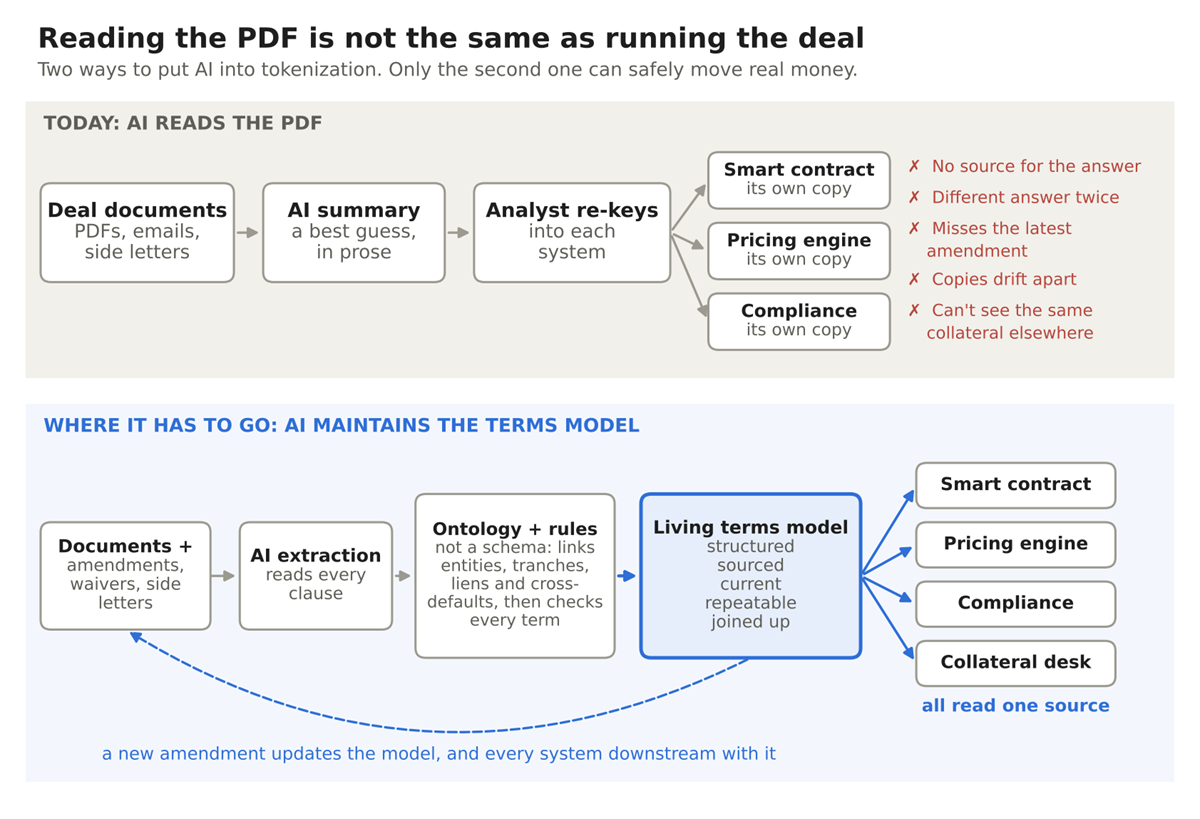
The scarce asset in tokenization is not the token, the blockchain or the AI model. It is the terms model: a machine-readable, source-linked, continuously updated record of what an asset is, what it obliges, and what else has a claim on it. Think of it as the asset’s GPS map. Smart contracts, pricing, compliance and the lending desk all navigate by it, and none can be more accurate than the map. A production-grade terms model is:
- Structured by a domain ontology, so it knows a fee from a covenant and how each changes the cash flows;
- Sourced, every value linked to its clause and page;
- Current, reflecting every amendment, waiver and side letter;
- Repeatable, the same answer to the same question every time; and
- Joined up, aware when the same collateral is pledged elsewhere.
Why a chatbot cannot do this alone. General-purpose AI models are brilliant readers but creative writers. Across a 200-page loan agreement, they will eventually invent a clause, give two answers to the same calculation, or miss the fourteenth amendment. Tricolor collapsed in 2025 amid allegations that the same loans were pledged to more than one lender. When the contract executes itself, one invented clause is a mispriced asset. The fix: wrap the AI in an ontology and hard rules that check every term against its source before it touches real money. An ontology is not a database schema. A schema maps fields; an ontology knows how they relate: that the guarantor of one tranche is the borrower’s parent, that a lien on one subsidiary is collateral for another, that a default on one loan triggers a cross-default on three more.
Why it is hard to copy. Three barriers compound: data (years of real credit agreements and amendments, held inside lenders and administrators, not on the open web); domain logic (an ontology that encodes how private credit actually works, which takes practitioners, not just engineers); and accountability (someone must stand behind the output, as an auditor stands behind a financial statement). Once lenders, administrators and custodians all read from the same model, switching becomes expensive, and the owner looks more like infrastructure than software.
Who is closest to owning it
The pieces exist; the whole does not.
| Player | What they hold | What’s missing |
|---|---|---|
| Standards bodies (ISDA’s Common Domain Model, now open-source at FINOS; ACTUS) | The grammar: machine-readable derivatives and cash-flow math | Bespoke private-credit terms; no one keeps each deal current |
| Fund administrators and transfer agents (SS&C, Citco, Apex, Securitize) | The official investor register and fund value | Clause-level terms still live in PDFs |
| Covenant-data specialists (Octus, 9fin) | Expert covenant extraction from credit agreements | Built for analysts, not for code that moves money |
| Private-market data platforms (Inveniam) | Documents turned into verified, machine-readable data, with provenance anchored on-chain | Proving data is untampered is not a live, executable rulebook; still early |
| Born-digital lenders (Figure) | Clean on-chain loan data: $50 billion+ processed | Only for loans they originate |
| Market infrastructure (DTCC, Chainlink) | The rails, and standards to carry data on-chain | They transport the truth; they do not author it |
Our read: the likeliest owner is an administrator or covenant-data specialist that adds execution-grade rigor, or a lender consortium that funds an open standard and lets implementations compete. A general-purpose AI lab is least likely: the barrier is data and accountability, not model size. The winner becomes the DTCC of the intelligence layer: not the most visible player, but the one everyone depends on.
Case study: the 3 a.m. collateral release
An illustrative scenario, adapted from Jay Smith’s work on agent governance.
It’s 3 a.m. A borrower owes $9 million, secured by $12 million of tokenized collateral. The lender applies a 20% “haircut” (a safety discount), so the collateral counts for $9.6 million. The borrower asks for $500,000 of it back.
An AI agent checks the current rulebook, including last month’s amendment requiring a Treasury sign-off. The credit team approves on one condition: the loan must stay covered. Treasury signs off. Then, minutes before the release, credit raises the haircut.
| If the haircut rises to… | The remaining $11.5M counts for… | The agent… |
|---|---|---|
| 21% | $9.085M, still covered | Re-checks the math and releases. No human wakes up. |
| 25% | $8.625M, not enough | Refuses the release automatically. |
Two plot twists. A second agent requests another $500,000 at the same moment; each request passes alone, but together they would under-cover the loan, so the system blocks the second. And if credit withdraws its approval, the release stops, even though the math works.
The takeaways. The AI is replaceable; the job description is not. Swap vendors and the rules stay put: hire the office, not the bot. Routine decisions run at machine speed, only genuine exceptions reach a person, and the final check happens where the money moves. That is the self-driving asset, with brakes.
Part IV: The prize and the playbook
What the prize is worth
Our illustrative model of a $1 billion tokenized private credit portfolio run on a production-grade terms model. Each line rests on a cited anchor or stated assumption. The value is shared across managers, borrowers and investors, so read the total as the size of the pie, not one party’s profit:
| Where the value comes from | Anchor and assumption | Per $1B a year |
|---|---|---|
| Lower running costs | Calastone’s manager survey: 0.13% of assets saved on mainstream funds. Private funds cost more to run, so a floor | $1.3M+ |
| Cheaper borrowing | 20% of the portfolio pledged as collateral, funded 1.0–1.5 points cheaper | $2–3M |
| Better exit prices | 10% trades each year; a trusted live value narrows today’s 2–5% sale discount (Keyrock) by 1–2 points | $1–2M |
| Fewer losses | The asset passport avoids collateral-integrity losses of 0.10–0.20% a year, the failure alleged at Tricolor | $1–2M |
| Total | Equivalent to 0.5–0.8% of assets a year, against typical private credit yields of 8–14% | ≈ $5–8M |
Now scale it. Without AI, we estimate 1–2% of the $24 trillion private market is tokenized by 2030, mostly standardized funds and loan pools. With terms models opening direct lending, asset-based finance and secondaries, 3–6% is within reach. That gap, roughly $0.5–1 trillion, is the AI dividend. Early fees go to distributors and platforms; over time, value migrates to whoever owns the terms model, because everyone else pays to read it.
What could break
The most dangerous failure modes are the least obvious.
- Amendment lag. A deal changes on Tuesday; the terms model catches up on Friday. For three days, every system reading from it executes yesterday’s contract, perfectly and at machine speed. The more trusted the model, the costlier the lag.
- Ontology drift. Lawyers invent structures faster than ontologies absorb them. A novel payment-in-kind toggle gets forced into the nearest existing category, and the error stays invisible until cash is distributed.
- Liability without an owner. If the 3 a.m. agent executes on a stale haircut, who pays: the lender, the AI vendor, the custodian or the model’s administrator? The answer is largely untested in court. Until contracts or regulatory safe harbors settle it, the working answer is parallel shadow ledgers and human sign-off on any exception above a set materiality threshold: prudent, but a bottleneck that caps the velocity and the gains above.
- Liquidity deserts. Tokenized does not mean liquid. Most tokenized funds are minted and redeemed, not traded, and sellers of tokenized bonds face 2–5% discounts. Instant settlement of a trade no one makes is worth nothing.
- A single point of truth is a single point of failure. If one terms model becomes the standard, one error reaches every lender and custodian that reads it. Removing reconciliation also removes the redundancy that used to catch mistakes.
- Half-written rules. In September the CLARITY Act stalled in the Senate, while the SEC opened a five-year exemption for tokenized public stocks. Private funds remain largely limited to accredited investors. The public path is opening; the private one is waiting.
What to do Monday morning
If you manage assets
- First 30 days: pick one evergreen credit vehicle and measure days from period-end to published value, and the share of its terms that live only in PDFs.
- By 90 days: build its terms model before its token, every term sourced and every amendment owned.
- By 180 days: halve the time to publish its value, then tokenize a share class.
If you allocate capital, ask every tokenized fund four questions before paying for “liquidity”: Can a machine read the terms? How fresh is the value, and who verifies it? How fast do amendments reach the model? Who buys this from me, and at what discount?
If you build technology, skip the next blockchain, and don’t build another siloed app. Build the adapter that connects legacy loan-servicing systems to on-chain state, anchored in a living rulebook for one slice of private credit. Prove it against real amendments and cash flows, and compete on accuracy and speed of update, not model size.
Our five calls for October 2027 (hold us to them):
- An open, machine-readable standard for private credit agreements launches.
- A top-20 alternative asset manager publishes a daily, AI-checked fund value on-chain, signed off by its auditor.
- The first notable tokenized-credit loss is traced to a data error, not a borrower default.
- Tokenized real-world assets reach $60–90 billion, roughly double today.
- Private credit, not real estate, remains the private asset that matters on-chain.
Where 1+1=11
We started with plumbing. This time the pipes are blockchains, and what flows through them is knowledge about assets: what they are, what they are worth, who owns them and what they owe.
Tokenization alone is a faster wrapper on an old process: settled in seconds, valued once a quarter. AI alone is a smarter back office on the same slow rails. Together, they produce the self-driving asset. It knows what it is and what it is worth, pays, collects and flags its own problems, and can be pledged or sold at 3 a.m. on a Sunday, to a person or an agent, with brakes that work.
The ledger will become a utility, as plumbing always does. The durable advantage belongs to whoever owns the truth that flows through it. The winners will not be the firms that mint the most tokens, but the ones whose assets understand themselves.
Start with the data. Let AI provide the intellect. The ledger will follow.
Authors
Jim Francis, Technology Futurist & Optimist, CEO / Founder ConceptVines
Contact: linkedin.com/in/jimgfrancis, www.conceptvines.com
Jay (Ralph) Smith, Blockchain Entrepreneur & Tokenomics Expert. President, Genialt AI and DeFi Devs; Senior Tokenomics Advisor, Certen Protocol; Chairperson, Accumulate Governance Committee; former COO, Factom; former Distinguished Engineer – Blockchain, Inveniam
Contact: linkedin.com/in/jaysmithpmp
Disclosure: both authors have commercial interests in enterprise AI and digital-asset infrastructure. Nothing here is investment advice.
Previous Redline reports: “Frenemies with Benefits” (seeing the bigger forest through the trees), “Start in the Mailroom” (an inside-out path to deploying agents), “The Butler-Barrister” (the rise of safe personal agents), “Rembrandts in the Attic” (monetizing dormant IP and assets with AI), “Empty Cathedrals” (AI data centers without the applications) and “The Six-Month Lease” (frontier AI as a fast-depreciating asset).
Sources referenced: DTCC press releases, Forkast and Markets Media on the DTCC Tokenization Service and Collateral AppChain; ARK Invest’s Big Ideas 2026, with coverage from Decrypt, Frontier Stocks and Tiger Brokers; DeFiLlama, RWA.xyz and Token Terminal via Cointelegraph on market size; McKinsey (via Ledger Insights) and Citi on 2030 forecasts; Savills, the World Federation of Exchanges, SIFMA, the World Gold Council, McKinsey’s Global Private Markets Report 2026 and Deloitte’s Art & Finance Report on total market value; Coin360, Alea Research, CMC Markets and KuCoin on Robinhood Chain; Ryder, Stobox, Nasdaq (Apollo and Securitize), AeraPass and LearnSignal on asset-class data; Chainlink on private market funds and its Digital Transfer Agent standard; SettleMint documentation on manual fund valuation; arXiv on agent-governed tokenization; ISDA, FINOS and Markets Media on the Common Domain Model; Crypto Briefing on Figure; Inveniam on private-market data infrastructure; Rithm Capital on Tricolor and First Brands; Calastone on tokenization cost savings; Keyrock and Stobox on liquidity; Orrick and Skadden on US regulation. Video interviews from CNBC (Larry Fink, Vlad Tenev) and AIBC World (Jenny Johnson); BlackRock’s 2026 annual chairman’s letter. The case study is adapted from Jay Smith’s work on agent governance. SAM shares, value-per-$1B and AI-dividend figures are the authors’ illustrative estimates, built on the anchors and assumptions stated in the text.