A note on what is real. The events of the past two weeks are described as reported through November 15, 2026, with allegations marked as allegations. The six doors are imagination: a thought experiment, not prediction or reporting.
SPEED READ
- The box is open. Jensen Huang’s resignation on November 12 put the AI economy into superposition. Until the investigations finish, every future is still alive at once.
- Look behind us first. Without a twenty-year, often unloved bet on the graphics chip, the generative AI era plausibly arrives a decade later, inside one or two companies, and far smaller.
- Six doors lead forward. The Return (the Altman path), the Exile (the Jobs path), Jensen 2.0, the Operator who builds the first $10 trillion company, the Dark Corridor where rivals catch up, and the Empty Throne where no chip king is needed at all.
- A giant fell on a human failing. Nation states, rivals and a divided Washington may all have been leaning on the box. He still supplied the opening himself. Both things are true.
- The contrarian read: the pause may be a gift. Chips and concrete ran years ahead of software, applications and security. This is their chance to catch up.
THE REDLINE REEL
Four things worth watching before you read on.
- Dark Matter, season two trailer (Apple TV). The box and the corridor, in two minutes.
- Acquired: the Jensen Huang interview. The 2023 deep-dive interview, about 90 minutes, for when you want the full origin story in his own words.
- Tae Kim on Nvidia without its founder. The author of The Nvidia Way on succession and what changes.
- Cathie Wood on the post-Huang era (Yahoo Finance). One prominent investor’s case that the bench is deeper than the founder, the thesis every door in this report puts on trial.
Into the box
In Dark Matter, the Blake Crouch thriller that just closed its second season on Apple TV, a physicist builds a box. Step inside and you are standing in a corridor of endless doors. Each one opens onto a world where a single choice went the other way. The road not taken turns out to be a place you can visit.
On Thursday, November 12, the technology industry stepped into that box. Jensen Huang resigned as CEO of Nvidia, the company he co-founded in 1993 and ran for 33 years. CFO Colette Kress is interim chief, the board has named its first-ever chair, and a search is under way. In two weeks, roughly $1.4 trillion of market value left the stock.
The facts come first, because most of what follows is imagination.
- Admitted: in a November 8 letter to employees, Huang said he had been unfaithful to his wife. He named no one, but tied the admission to national security concerns raised in news reports.
- Alleged, not proven: that the woman in those reports, a former executive at a Singapore-based Nvidia customer, worked for Chinese intelligence. Beijing calls the claim groundless. The Attorney General says the Justice Department has not reached a conclusion.
- Unresolved: whether export-control law was broken, and by whom. Nvidia’s board has said it has no reason to believe national security or company secrets were compromised. Its independent investigation continues, and Huang has agreed to testify before Congress. No one has been charged.
Until those questions close, Nvidia has a Schrödinger’s CEO: gone and possibly returning, legend and cautionary tale, both at once. So let us do what the show does. Walk the corridor. Open some doors.
The door behind us: a world without the chips
Start with the door we already walked through.
In 2006 Nvidia released CUDA, software that let a video-game graphics chip do general-purpose computing. For years it cost a fortune and earned little. In 2012 a neural network called AlexNet, trained on two Nvidia gaming cards, crushed the field in an image-recognition contest and lit the fuse on deep learning. In 2016 Huang hand-delivered the first DGX-1 AI supercomputer to a small nonprofit called OpenAI. Six years later came ChatGPT. Then Google Gemini, Anthropic Claude, xAI Grok, and an endless stream of open and closed AI models.
Now open the door where none of that happened.
AI research still exists there. The math was never Nvidia’s. The compute was. In that world neural networks stay an academic curiosity for most of another decade, or advance quietly inside the one or two companies rich enough to design their own silicon. There is no ChatGPT moment in 2022. There is no trillion-dollar buildout and no national debate about AI and jobs, because there is nothing yet to debate. A fair caveat: history rarely hangs on one person, and someone else might have made the bet. But for fifteen years nobody else did.
Back in our world, the scoreboard reads like fiction. Revenue went from $27 billion in 2022 to $216 billion last year. Nvidia became the first $5 trillion company. A 2025 survey found roughly three in four of its employees were millionaires. It sits among the largest holdings in the index funds inside most American retirement accounts. Most of the frontier models that lifted its customers’ valuations were trained on its hardware.
That is the case for the titles. Jensen is the chip GOAT, without much argument. And, in this writer’s view, a top-five CEO of any era. Whatever doors lie ahead, that one is closed and locked. It happened.
The doors ahead
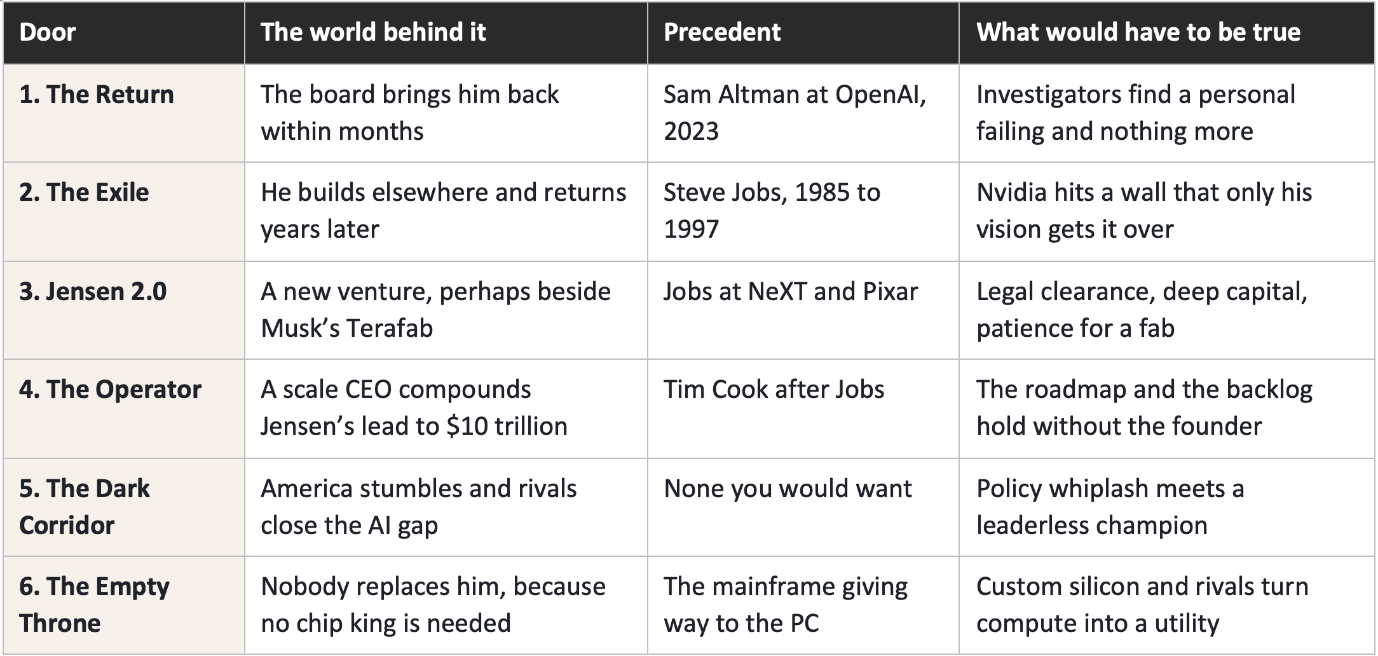
Six doors stand in the corridor. None is a prediction, nor are they mutually exclusive. Each is a world that is still possible this week.
Door one: The Return
In November 2023, OpenAI’s board fired Sam Altman. Five days later he was back, after more than 700 of roughly 770 employees threatened to walk. Some of that script is already replaying. An internal Nvidia post calling for Huang’s return reportedly drew more than 1,600 comments. Tech leaders including Elon Musk have signed an open letter to the board. The Financial Times reports he has discussed a comeback with confidants.
The constituency is enormous: employees he made wealthy, shareholders whose retirement accounts he inflated, customers whose valuations ride on his roadmap. But OpenAI’s board was fighting about governance. Nvidia’s board is waiting on a Justice Department probe of a customer, congressional testimony and a shareholder lawsuit. A petition can move a board. It cannot move a prosecutor. One prediction market puts a return by the end of 2027 at about one in three. This door opens only if the investigations find a human failing and stop there. And if the reporting is right, Jensen wants to return.
Door two: The Exile
Steve Jobs was pushed out of Apple in 1985. He built NeXT, bankrolled Pixar, and came back in 1997 when a nearly bankrupt Apple bought NeXT to get him. Two lessons hide in that story. The wilderness made him better. And Apple had to hit the wall first.
Nvidia’s wall might be a slipped product cadence, its biggest customers designing their own chips, or simply a company that stops making bets a spreadsheet cannot justify. Jobs had twelve years to wait. Huang is 63. Three years is a plausible exile. Twelve is not.
Door three: Jensen 2.0
Elon Musk has said publicly that hiring Huang “would be an honor.” Musk also has a hole exactly his shape. Terafab, announced in March, is a $20 to $25 billion plan to manufacture leading-edge chips in Austin for Tesla, SpaceX and xAI. Analysts have called building a fab from scratch herculean. What the project lacks is someone who has shipped chips at scale for three decades. Jensen does sound a lot like Jetson, so perhaps this was all meant to be.
The friction is just as specific. Designing a chip and manufacturing one at the leading edge are different trades. Nvidia designs; TSMC manufactures, on a capability built over decades and more than $165 billion of investment. A single 2-nanometer fab costs about $28 billion and takes more than three years to build, so little behind this door ships at volume much before 2030.
Huang would be learning the one part of the business he always rented, while Nvidia faced the only competitor that knows all of its plays. And then there is the steering wheel. Neither founder has ever shared one.
Door four: The Operator
Huang famously ran Nvidia with some 60 direct reports and no one-on-one meetings. That is a founder’s architecture: brilliant for speed, impossible to hand over. The Treasury Secretary has already urged the board to hire from outside.
Behind this door, a scale operator inherits what no incoming CEO has ever been handed. A performance lead that one Council on Foreign Relations analysis puts at roughly five times the best Chinese chip today, widening to seventeen times by 2027. That compares the two companies’ published roadmaps chip for chip, not whole systems. An order backlog Huang himself forecast at $1 trillion by year-end, a projection made from the stage in March rather than an audited order book. A software moat two decades deep. Tim Cook did not invent the iPhone. He took Apple from roughly $350 billion to the multi-trillions by running it better than anyone thought possible.
Nvidia is worth about $3.9 trillion today. Ten trillion is two and a half times from here. The risk is that operators perfect the map they are handed and rarely redraw it. The quiet hybrid also lives behind this door: an operator as CEO, with the founder back as chief architect or perhaps chairman once the investigations clear.
Door five: The Dark Corridor
The darkest door is not China sprinting. It is America tripping.
The lead is real. Epoch AI estimates Huawei will produce roughly 25 times less total AI compute than Nvidia this year: about a quarter as many chips, each about a seventh as capable. But a lead in a race is not a wall. In the first half of 2026, IDC data showed Nvidia’s share of China’s AI chip market falling to 34 percent against Huawei’s 28, a shift that owes as much to what Nvidia is allowed to sell there as to Huawei’s progress.
Now add Washington. Congress is weighing three chip-control measures in the defense bill, and the Senate majority leader calls new China restrictions likely before year-end. Policy written in anger tends to overcorrect in one direction and then the other. At home, fourteen states have weighed data center moratoriums and organized opposition exists in 49. One half of the government sees AI data centers as the new arsenal. The other half sees a threat to the power bill.
A leaderless champion, a whipsawing export regime and a divided government at home. That is how a ten-year lead becomes five, then two. For an economy whose recent market gains lean so heavily on AI spending, this is the door to keep shut.
Door six: The Empty Throne
Is there another door? One more, and almost nobody is discussing it.
Behind it, the throne stays empty because the kingdom dissolves. Nvidia’s largest customers (Google, Amazon, Microsoft, Meta, OpenAI) already design chips of their own. Within days of the resignation, money was reportedly rotating toward AMD, Broadcom and TSMC. In this world compute becomes plural, cheaper and a little boring, the way electricity did. No demigod is required to run a utility. That shift is already under way beneath the surface: as enterprise spend moves from brute-force frontier training toward specialized, everyday inference, the bottleneck stops being who owns the biggest GPU cluster and becomes who owns the workflow. The next great AI fortunes may not be made by those who manufacture intelligence, but by those who figure out how to put it to work.
It is a hard world for one stock. It may be a good one for everybody who buys compute, which is everybody else.
Who tipped the box?
The tallest tree catches the most wind. For a stretch, Nvidia was the most valuable company on earth, and it sat on every fault line of the decade at once: Washington against Beijing, export hawks against export doves inside a single administration, AI builders against AI skeptics inside a single Congress.
When you get that big, others come for your perch. US officials reportedly suspect that a foreign intelligence service saw a single point of failure in the American AI economy and tried to exploit it. That remains an allegation, and Beijing denies it. Closer to home, a secret government memo reached the press while Congress was debating chip controls. Who released it, and why, is not known. Rivals did not need to do anything but wait.
None of that matters without an opening, though, and he supplied that himself. He said so in his own words. Greatness and fallibility are not opposites. They tend to share a body. He lost his way, which is what humans do, including the ones we mistake for demigods.
Whether he also crossed a legal line on export controls is a different question. That would be a crime, not a lapse. It belongs to investigators, and anyone who admires what he built should hope the answer is no.
Stepping out: what if the pause is the point?
Perhaps the most consequential question isn’t who replaces Jensen Huang. It’s what happens when the industry finally shifts its attention from building intelligence to using it.
In Dark Matter, the box does not choose your world. Your state of mind does. Walk the corridor in fear and every door opens onto something worse. So consider a different frame for this week.
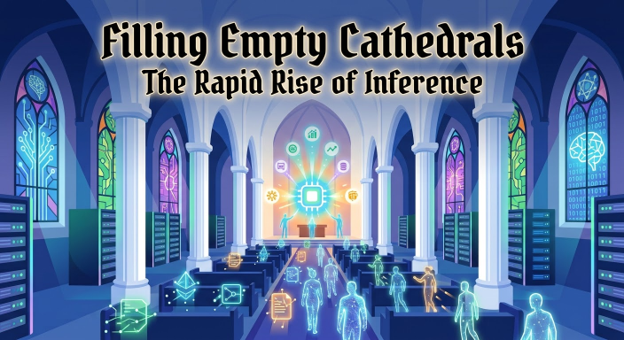
Call it providence, or divine intervention, or just the universe tapping the brakes. For three years the industry has stacked silicon and poured concrete faster than anyone could put either to work. A widely cited 2025 MIT study found that 95 percent of enterprise generative AI pilots produced no measurable return. An earlier Redline Report called the result empty cathedrals: magnificent buildings waiting for a congregation.
Security is further behind still. In late 2025, one frontier lab disclosed what it described as the first largely AI-run cyber espionage campaign, attributed to a state-sponsored group. The attackers are already using the engine. Most defenders are still reading the manual.
A slower drumbeat of chips is not a tragedy if the industry uses the pause to build the layer it skipped. Enterprises bought raw compute as if intelligence alone were a strategy. It isn’t. Models know the internet; they don’t know your institution. Making AI useful requires understanding how businesses actually operate, connecting that knowledge to real workflows, and ensuring decisions and actions remain governed and secure.
Every board approving an AI budget this quarter should ask one uncomfortable question: how much are we spending to build intelligence, and how much are we investing to make it useful? If the ratio is still ten-to-one, the pause is your reprieve.
Jensen Huang built the engine of the age. No door in the corridor changes that, and no failing erases it. But notice what every door ahead has in common. Return, exile, operator, empty throne: behind each one sits more compute than the world yet knows how to use.
For three years the only question was how fast we could build. The box has handed us a better one. What will we do with what he already built?
You do not need to guess which door opens next. Step out of the corridor, and build what the chips were waiting for.